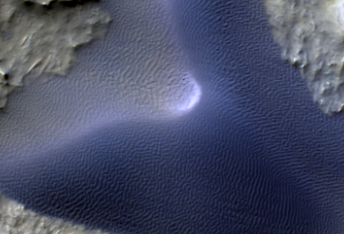
| Translucent Ice on Dunes Coordinating with the CaSSIS instrument on the ExoMars Trace Gas Orbiter, we acquired an image at this site for seasonal monitoring. At the time of year we took the image, the whole scene was probably covered in carbon dioxide ice. Some of this ice is translucent, so you can see the dark dunes through it. |

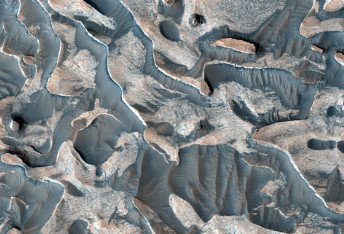
| South of Ares Vallis From HiWish: “The objective of this observation is to help us understand the flow that occurred between smaller rivers and larger rivers, and how it affected the landscape, as well as to investigate the different features that were created by sediment carried down by the force of the water. The objective will also help to study and understand how geological processes and different rock types affected the flow of ancient rivers on Mars.” | 
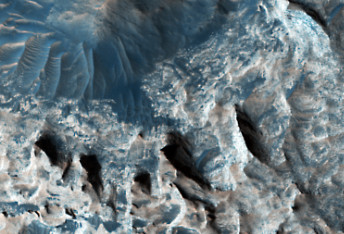
| A Crater Floor in Sinai Dorsa Most late-stage lake deposits are low elevation. Is this candidate lake deposit in an impact crater on the Tharsis plateau an exception? In Context Camera data, it looks like confirmed lake deposits. Important if so, because high-elevation lake deposits constrain climate models more stringently than low-elevation lake deposits. | 
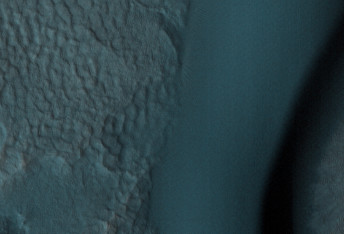
| Gullies with Extensive Debris Aprons These gullies in Terra Sirenum have very extensive and detailed debris aprons. This image will be useful in distinguishing repeated deposition events that helps us understand more about gully formation processes. Also interesting is that one of the debris aprons has a crater superposed on it. These could be older than most gullies, which might explain the volume of the debris aprons. | 
| The Two Graben of Melas Chasma In this image, we see a North-South trending graben crosscut by two East-West trending ones. The E-W graben show evidence of right lateral faulting. The top graben appear as left echelon faults; the bottom graben offsets the larger North-South graben by about 7 kilometers. Our observation may provide deeper insight into the regional structural geology of the Valles Marineris region. |