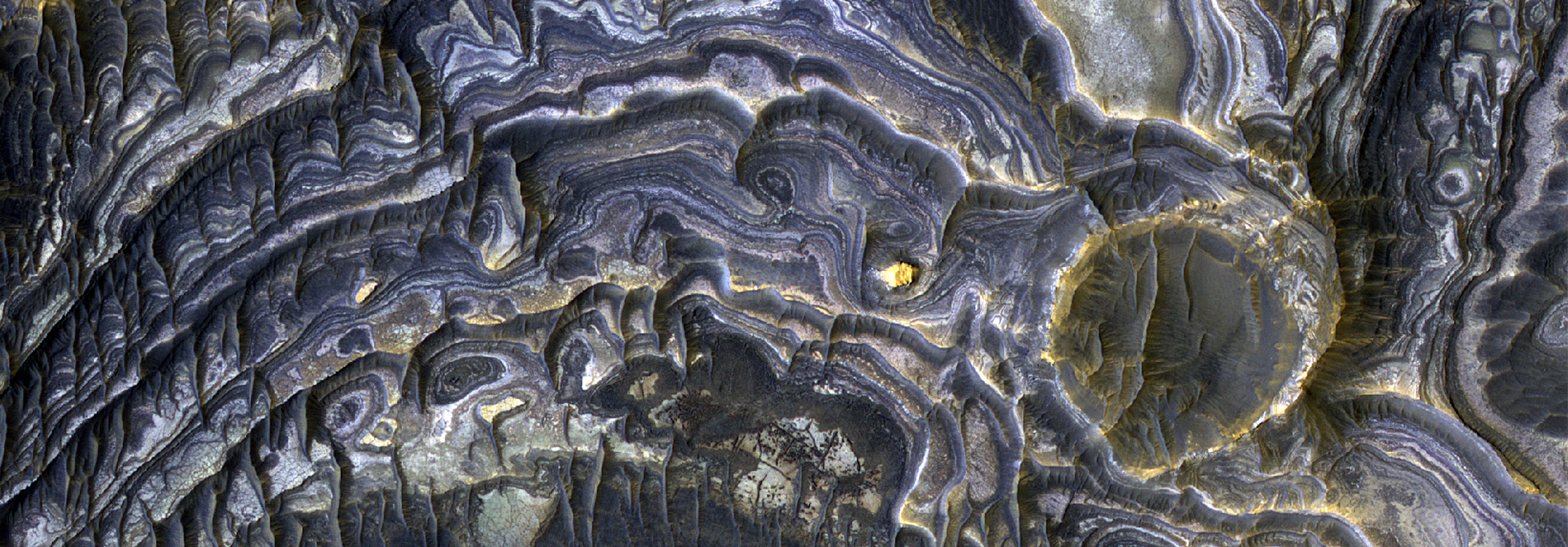
Martian Landform Observations Fill Special Issue of “Icarus”
Martian landforms shaped by winds, water, lava flow, seasonal icing and other forces are analyzed in 21 journal reports
based on data from a camera orbiting Mars.
The research in a January special issue of Icarus
testifies to the diversity of the planet being examined by the High Resolution Imaging Science Experiment (HiRISE) camera on NASA’s
Mars Reconnaissance Orbiter. Examples of the findings include:
Valleys associated with light-toned layered deposits in several locations along the plateaus adjacent to the largest canyon system
on Mars suggest low-temperature alteration of volcanic rocks by acidic water both before and after formation of the canyons.
The youngest flood-lava flow on Mars, found in the Elysium Planitia region and covering an area the size of Oregon, is the product
of a single eruption and was put in place turbulently over a span of several weeks at most.
New details are observed in how seasonal vanishing of carbon-dioxide ice sheets in far-southern latitudes imprints the ground
with fan-shaped and spider-shaped patterns via venting of carbon-dioxide gas from the undersurface of the ice.
About HiRISE
The HiRISE camera onboard the Mars Reconnaissance Orbiter is the most powerful one of its kind ever sent to another planet. Its high resolution allows
us to see Mars like never before, and helps other missions choose a safe spot to land for future exploration.
NASA’s Jet Propulsion Laboratory, a division of the California Institute of Technology in Pasadena, Calif., manages the Mars Reconnaissance
Orbiter for NASA’s Science Mission Directorate, Washington. Lockheed Martin Space Systems is the prime contractor for the project and
built the spacecraft. The HiRISE camera was built by Ball Aerospace & Technologies Corp. and is operated by the
University of Arizona.