Outcrops of Layers in the South Polar Layered Deposits
NASA/JPL/University of Arizona

Outcrops of Layers in the South Polar Layered Deposits
PSP_004664_0955  Science Theme: Polar Geology


Wallpaper
800  
1024  
1152  
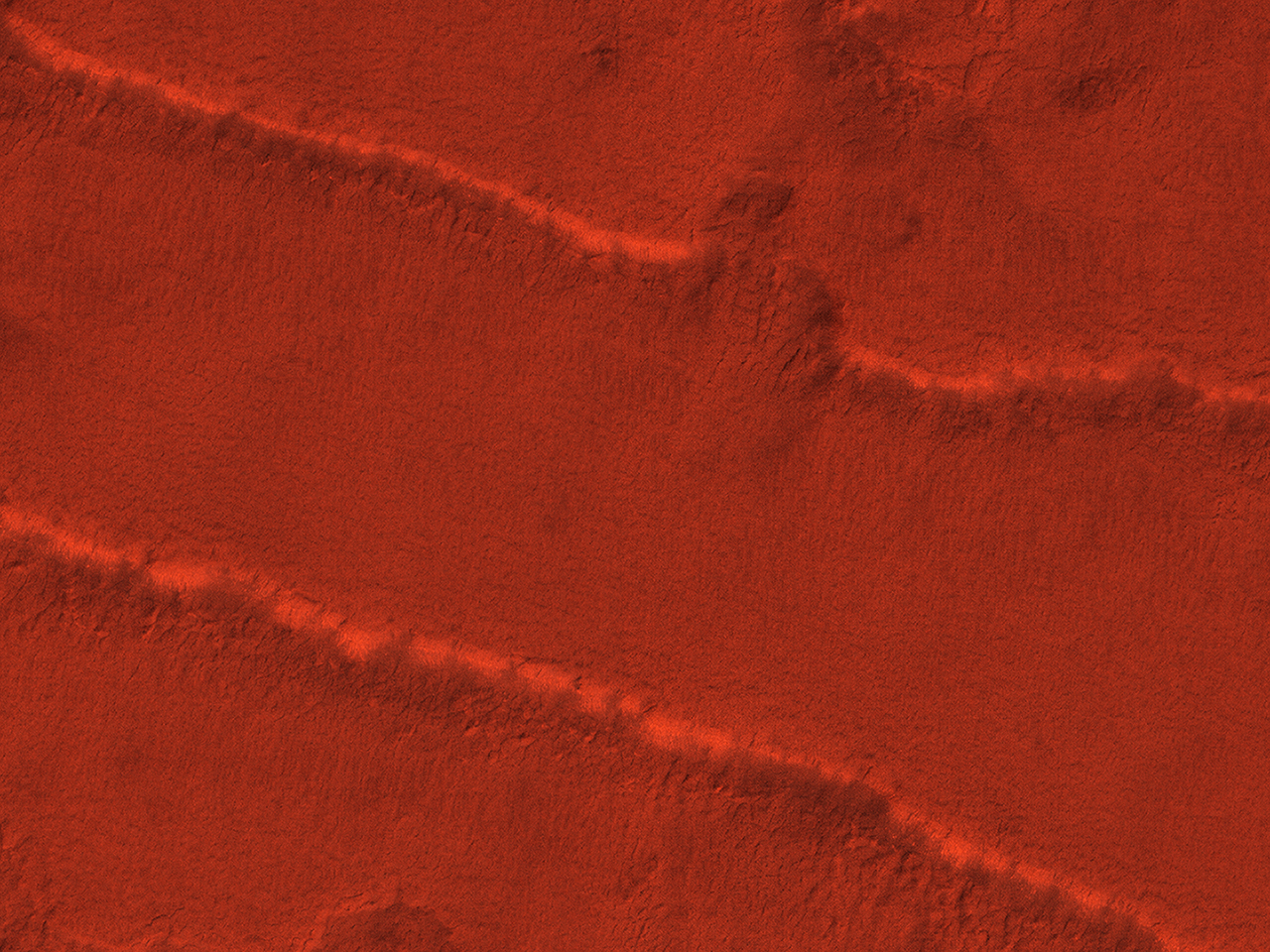
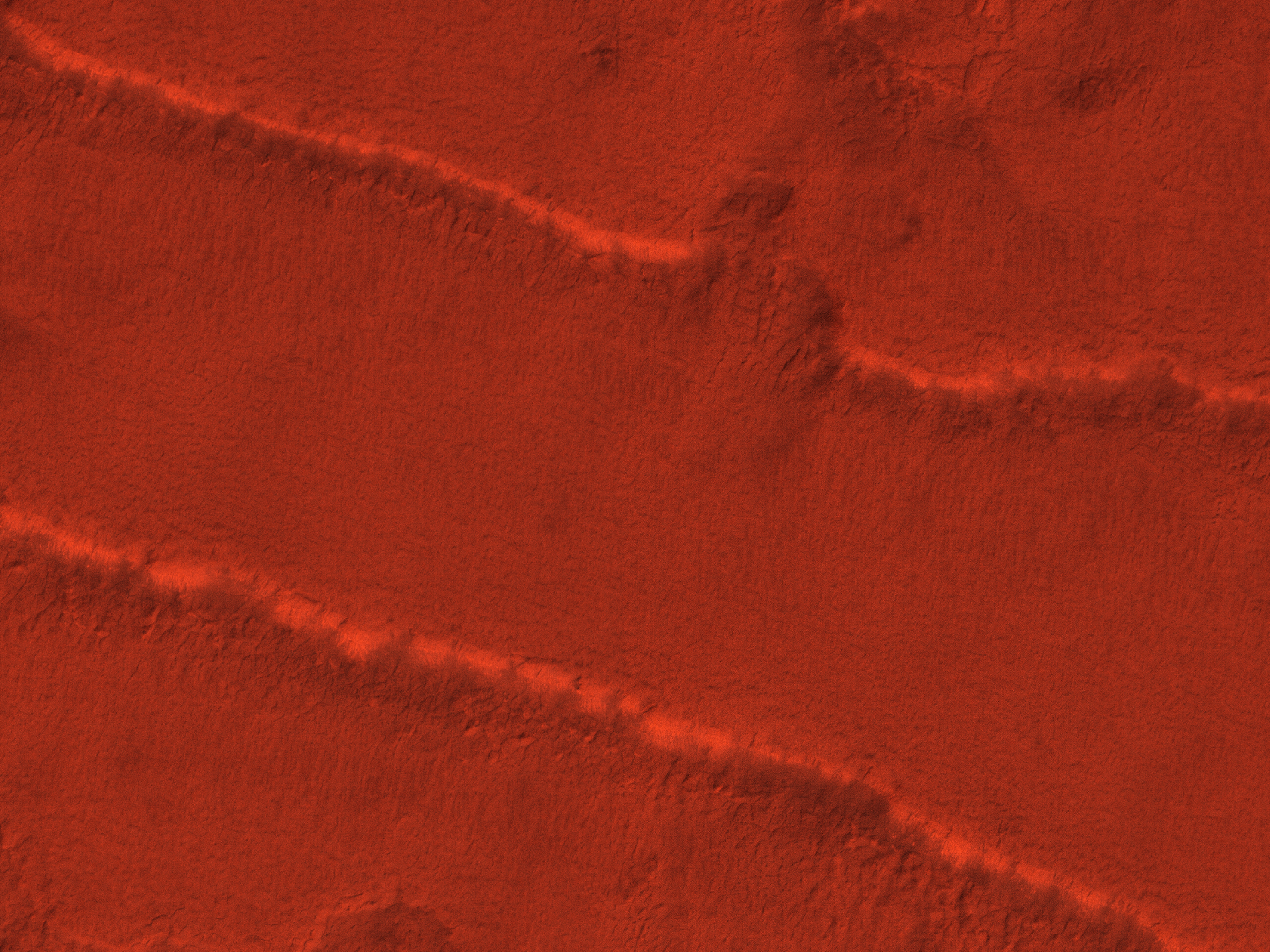
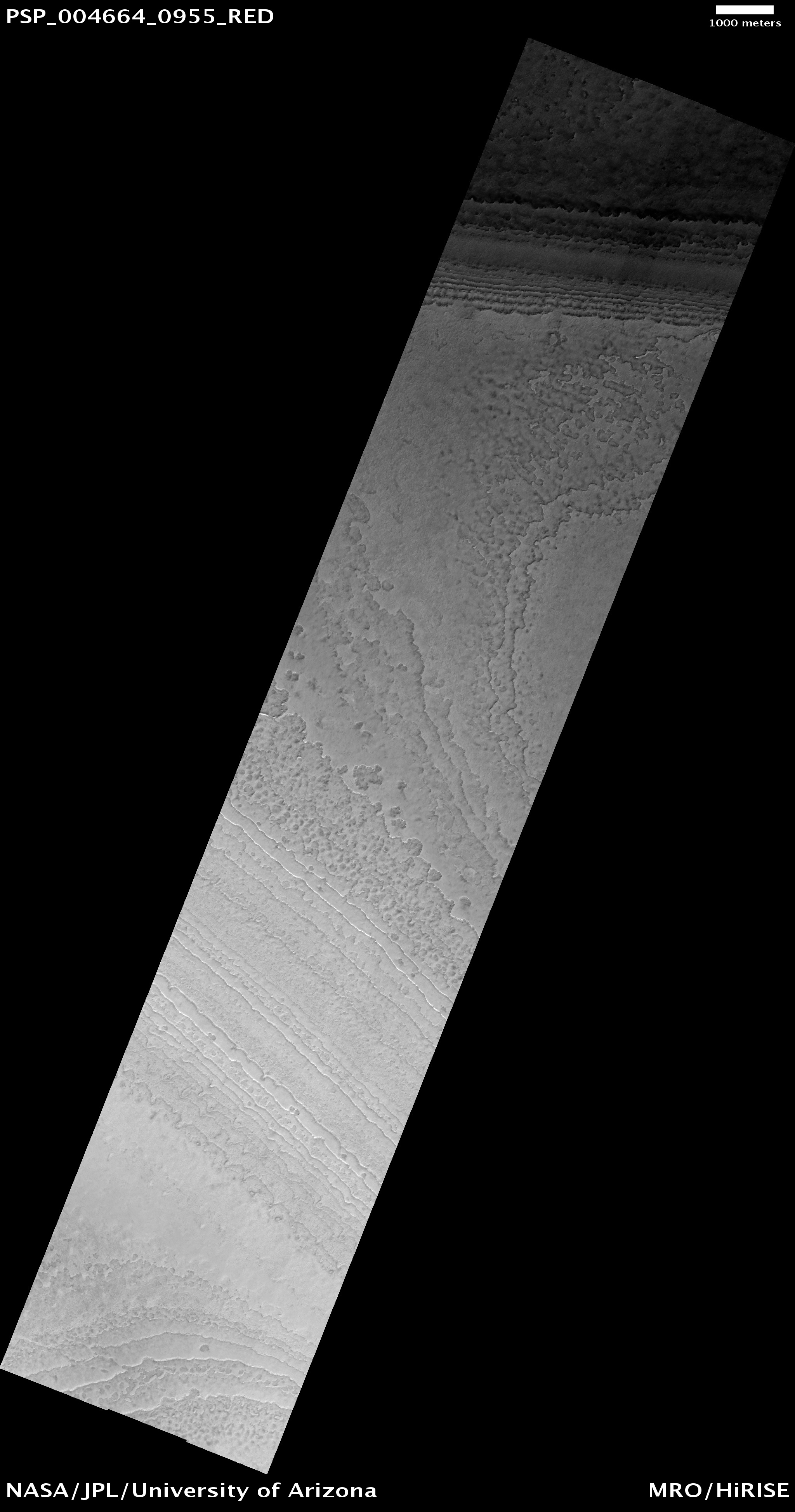
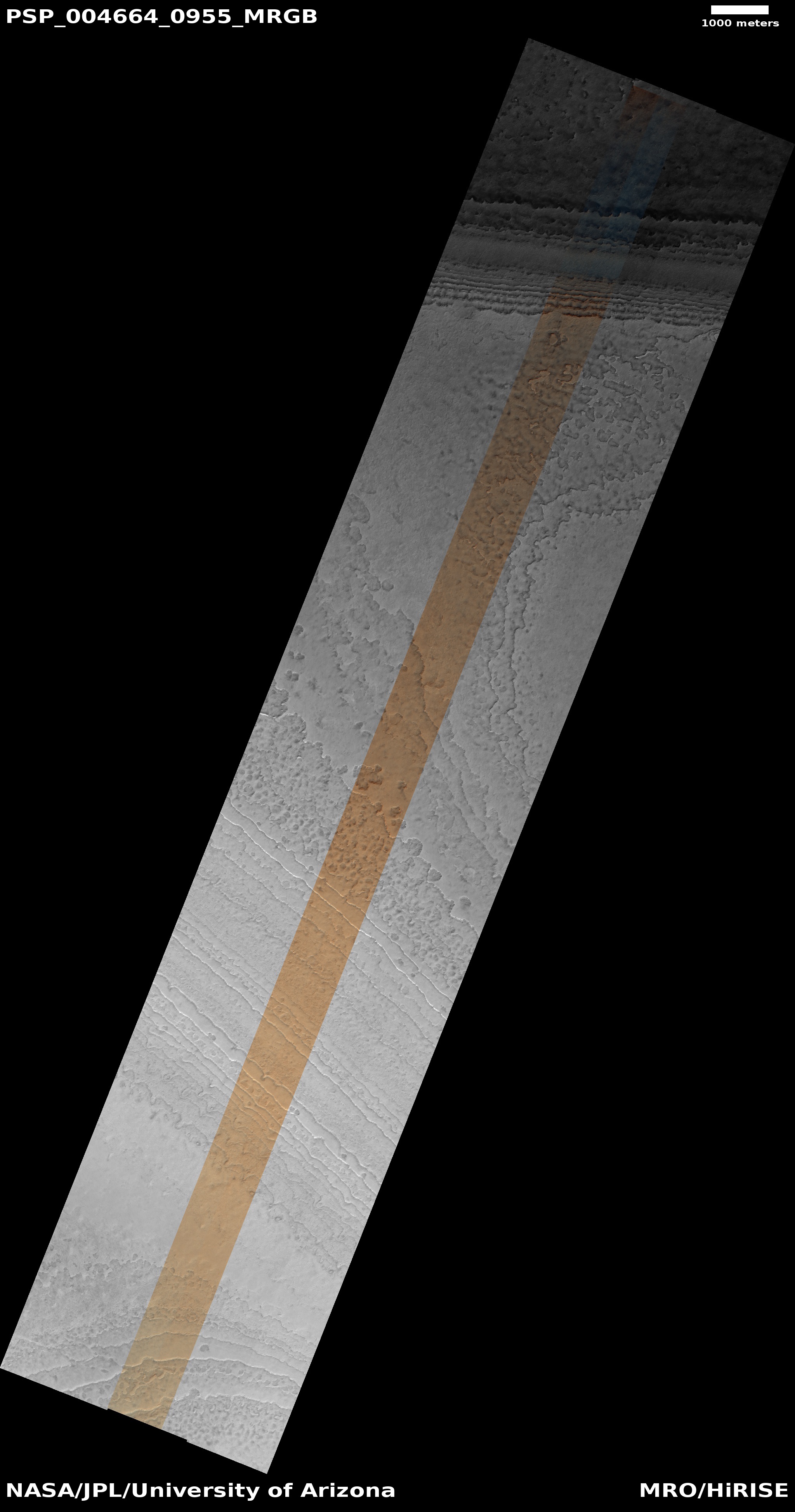
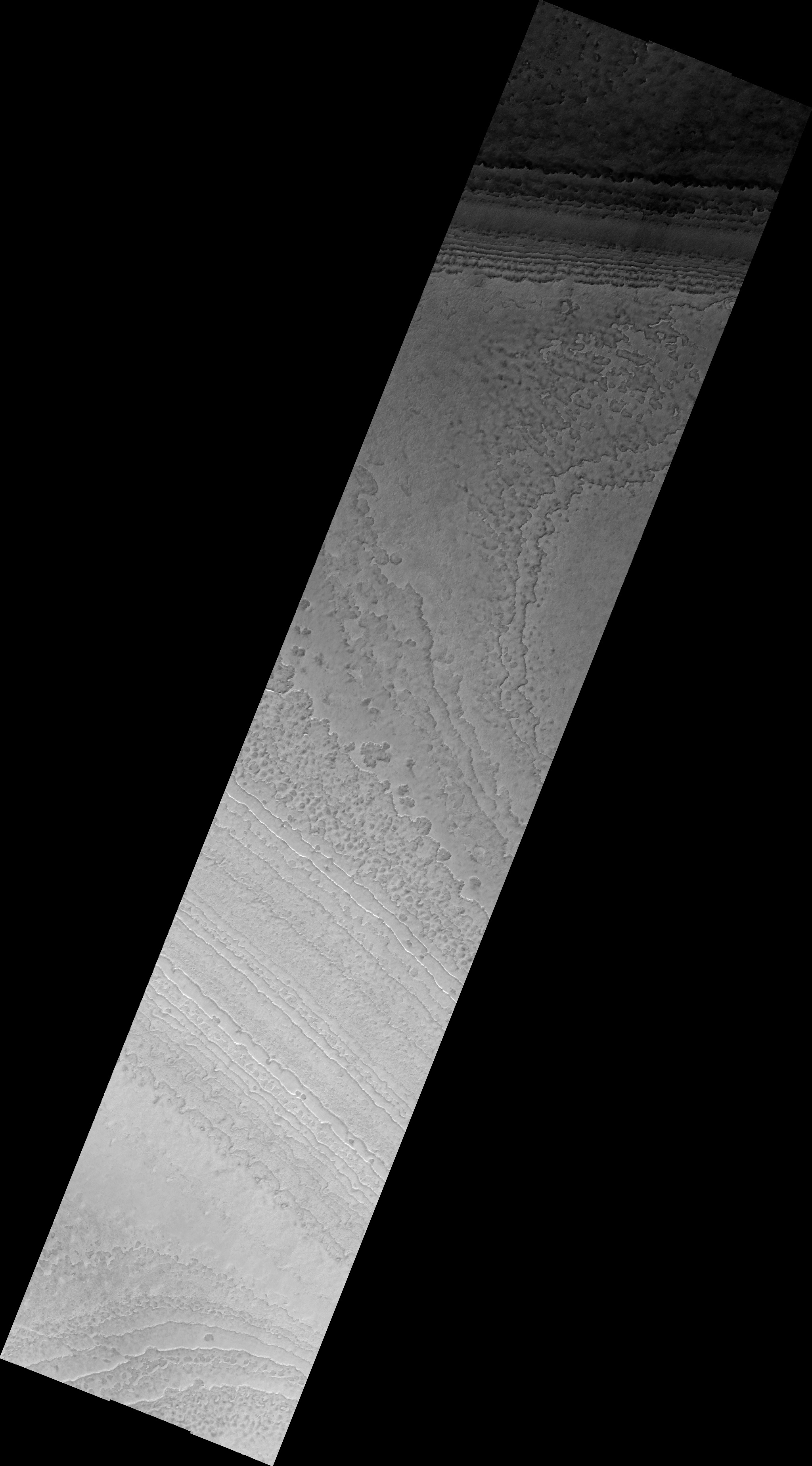
This image spans a section of the south polar layered deposits (SPLD). The SPLD are composed of layers of water ice mixed with impurities (probably mostly dust). The most similar terrestrial analog to the SPLD are ice sheets, like those covering most of Greenland and Antarctica.

The materials of ice sheets are deposited by freezing of atmospheric water vapor on dust particles and precipitation of those water/dust particles (snow), by direct condensation (freezing) of atmospheric water vapor onto the surface, and by fallout of dust. Together, these processes cause an ice sheet to undergo accumulation (build-up). Ablation (removal of material, also called erosion) of an ice sheet can also occur. If more accumulation happens than ablation, the ice sheet grows; if reversed, the ice sheet shrinks, as is the case for many of Earth’s glaciers due to global warming. Each year, the amount of accumulation and ablation varies, so layers of different thicknesses and different amounts of impurities (dust) will be deposited onto the ice sheet.

Volcanic eruptions anywhere on the planet can also potentially spew ash high into the atmosphere, where it can travel great distances and fall onto an ice sheet surface. Later accumulations of water ice can then trap this volcanic ash as a layer within the ice sheet. Thus, layers in an ice sheet can originate through a variety of means and occur at a variety of scales (thicknesses).

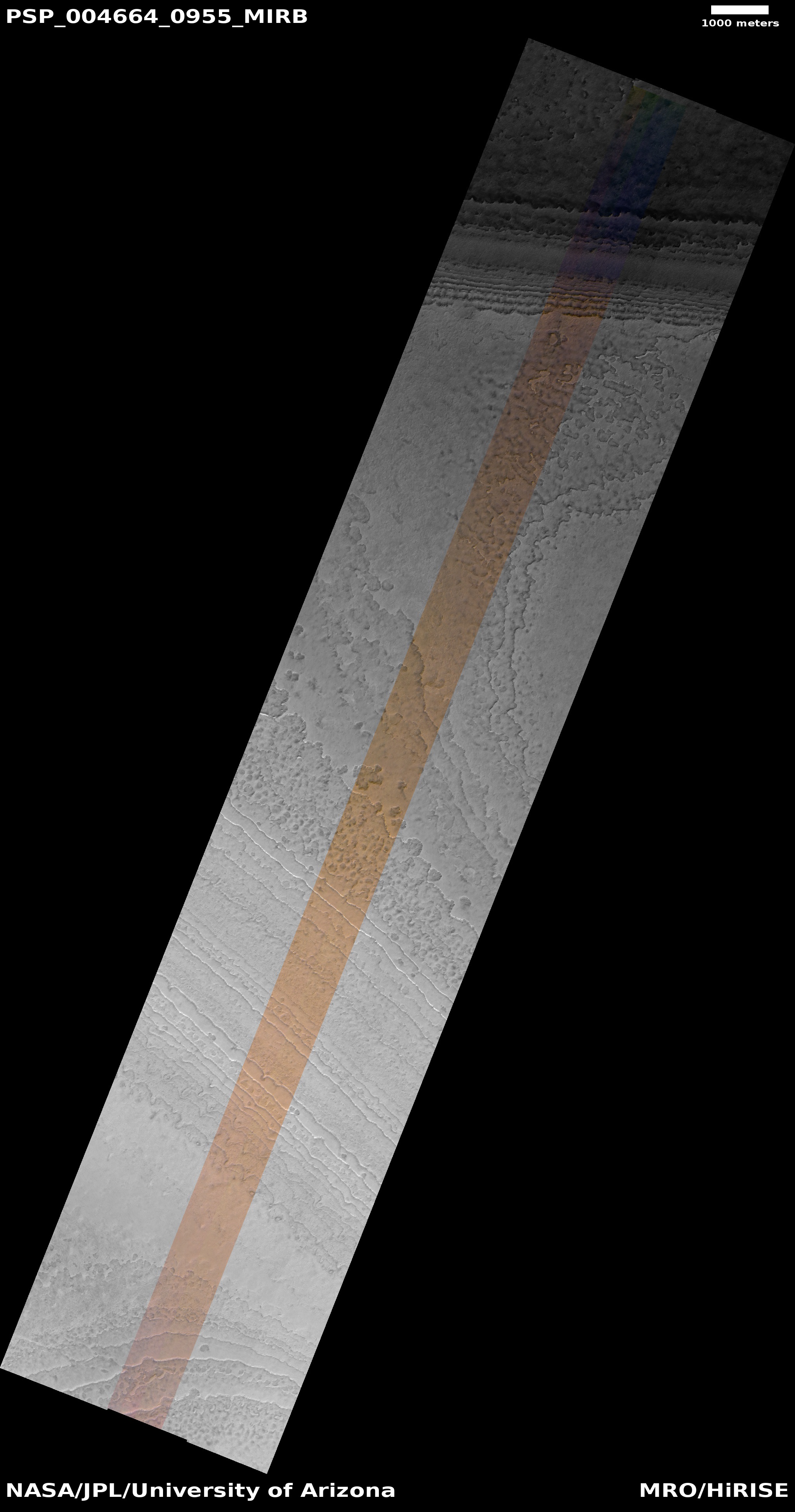
This particular image is interesting because many layers are exposed and because more than one outcrop (exposure of layering) is visible—at the top of the image and at the bottom. You can imagine the outcrops at the top and bottom of the image as if you are looking down on a staircase. The approximately horizontal lines are the edges of the layers (the risers), and the flat areas between them are the layer surfaces (the flat parts of the steps). The middle of the image is the top of the staircase. At the bottom, the staircase of layers goes down again.

The layers in this image are on the scale of meters (several to tens of feet) in thickness and are much thicker than one might expect from annual accumulation (which might be about 0.5 millimeters per year, or 0.02 inch per year). So the layers we see in this image may be packages of thinner, annual layers. The reason that we can distinguish between different packages of annual layers (in other words, the reason that we can see layering at this scale) is because the rates of accumulation and ablation change not only yearly, but also on much longer time scales. Imagine drilling into the SPLD and looking at the walls of the hole with a microscope. Within the large-scale layering we see in this image, we might see annual accumulation layers, dusty layers created during large dust storms, and maybe even volcanic ash layers.

Written by: Kate Fishbaugh   (14 August 2007)


 Image Products: All image links are drag & drop for HiView, or click to download
JPEG
Grayscale: map projected  non-map
IRB color: map projected  non-map
RGB color: non-map projected

JP2 DOWNLOAD
Grayscale: map-projected (1501.7 MB)
IRB color: map-projected (628.3 MB)

JP2 EXTRAS
Grayscale: map-projected  (907.2 MB),
non-map  (798.1 MB)

IRB color: map projected  (529.6 MB)
non-map  (1054.8 MB)


RGB color: non map-projected  (924.9 MB)
Additional Image Information
Grayscale label   Color label
Merged IRB label   Merged RGB label
EDR products

About color products (PDF)
HiView main page
HiRISE Online Image Viewer

 Observation Toolbox
Acquisition date:25 July 2007 Local Mars time: 4:24 PM
Latitude (centered):-84.2 degrees Longitude (East):229.1 degrees
Range to target site:248.4 km (155.3 miles)Original image scale range:from 24.9 cm/pixel (with 1 x 1 binning) to 49.7 cm/pixel (with 2 x 2 binning)
Map projected scale:25 cm/pixelMap projection:POLAR STEREOGRAPHIC
Emission angle:0.0 degrees Phase angle:63.3 degrees
Solar incidence angle:63 degrees, with the Sun about 27 degrees above the horizon Solar longitude:283.3 degrees, Northern Winter
For non-map projected products:
North azimuth:143 degrees Sub-solar azimuth:47.4 degrees
For map-projected products
North azimuth:139.1 degreesSub solar azimuth:70.56 degrees

    Nearby observations

Usage Policy
All of the images produced by HiRISE and accessible on this site are within the public domain: there are no restrictions on their usage by anyone in the public, including news or science organizations. We do ask for a credit line where possible: Image: NASA/JPL/University of Arizona
Postscript
For information about NASA and agency programs on the Web, visit: http://www.nasa.gov. NASA's Jet Propulsion Laboratory, a division of the California Institute of Technology in Pasadena, Calif., manages the Mars Reconnaissance Orbiter for NASA's Science Mission Directorate, Washington. Lockheed Martin Space Systems is the prime contractor for the project and built the spacecraft. The HiRISE camera was built by Ball Aerospace and Technology Corporation and is operated by the University of Arizona. The image data were processed using the U.S. Geological Survey’s ISIS3 software.